
The 10-Year Yield Closed at a 2026 High of 5.26% — Gold Cracked and Bitcoin Gave Back 4% From $87,395
Treasury data shows the 10-year yield closed at 5.26% on Sept 29, a 2026 high, while gold lost 2.8% in one session. Bitcoin is 4.4% below its $87,395 high.

The Bond Market Is Back in Charge
On 16 September the FOMC raised the target range for the federal funds rate by a quarter point to 3.75%-4.00% on a 12-0 vote and said plainly that inflation “remains elevated” (Federal Reserve statement). One policy decision, and then the bond market did the rest. The 10-year Treasury yield closed at 5.26% on Tuesday, up from 4.96% on 22 September — a 30-basis-point repricing in five sessions — and the highest close in the Treasury’s own 2026 daily series (daily yield curve). The 30-year closed at 5.59%, also a 2026 high, and the two-year at 4.89%.
That two-year number is the one crypto should read first. It sits 89 basis points above the top of the Fed’s new 4.00% range, which means the bond market is pricing more tightening rather than the end of it — even after New York Fed president John Williams said Tuesday that there is “no need for urgency” and that his base case is one more hike this year (CoinDesk live coverage). October hike odds fell to 51% from 70% in a single day on those remarks and the two-year traded down to 4.88%.
Advertisement
“With the policy action we took at our September meeting, there is no need for urgency, and we have time to gather more information.” — John Williams, Federal Reserve Bank of New York
Gold Showed What a 5% Yield Does to a Store of Value
Gold took the first hit. PAXG, the tokenised gold that tracks London spot on Binance, closed Monday at $4,139.20 for a 2.80% single-session drop — the heaviest day of September — after touching $4,122 intraday (PAXG/USDT). It has clawed back to $4,184 on Tuesday, but the metal is still 7.7% below its 3 September close of $4,482.51, and the futures session was violent enough that the Kobeissi Letter flagged it at a z-score of -2.90 against two decades of daily moves: a print that shows up roughly once every twenty years.
What matters for crypto is what gold and bitcoin share — neither pays a coupon. When the risk-free alternative yields 5.26% instead of 4.96%, the cost of holding a non-yielding asset rises by 30 basis points in a week. Gold is the cleaner read on that trade because there is no ETF-flow story and no halving narrative to hide a repricing behind, and it still lost almost three percent in a session.
Advertisement
Bitcoin Gave Back 4.4% and Built a Higher Low
Bitcoin’s own tape is orderly by comparison. The 21 September session printed a high of $87,395.67 and closed at $86,620 on the heaviest volume of the month, 31,963 BTC (BTC/USDT). Tuesday’s print is $83,565, about 4.4% below that high — and the pullback has produced a higher low: $82,775.94 today against Monday’s $82,563.
The geometry matters more than the percentage. September’s leg ran from $76,388.72 on the 14th to $87,395.67 on the 21st, an 11,007-point range. The 38.2% retracement of it sits at $83,191 and the 50% at $81,892, and price is holding between the two — the profile of a pullback, not a failed breakout. The candle that started the move, a $76,417 open to an $80,884 close on 23,908 BTC on 18 September, has not been given back.
The ETF Bid Did Not Leave — It Just Got Smaller
Flows say the same thing. Spot bitcoin ETFs took in about $2.4 billion across the five sessions through 25 September, their biggest week since October 2025, which turned the category net positive for 2026 after a $5.8 billion year-to-date hole was erased. BlackRock’s IBIT captured roughly $1.15 billion of that.
But the daily ladder shows the bid thinning as yields climbed: $999 million on 21 September, then $715 million, $347 million, $191 million and $135 million by Friday. Monday, with the 10-year above 5.2%, brought just $31.07 million — the lightest day of September — while ether funds added $17 million. That is not an exit. It is a buyer measuring the alternative.
What October Is Actually Trading
The calendar is dense: PCE inflation on 30 September, the September jobs report on 2 October, and the third-quarter close in between. The Conference Board’s consumer confidence index fell to its lowest level in more than a decade in September (Conference Board), which cuts both ways — a softening consumer is an argument for stopping, and an argument for holding dollars instead of risk.
The levels are clean. $84,563 is Tuesday’s high and the first thing a bounce has to reclaim; above it come $85,000 and the $87,395.67 September peak. Below, $82,563 is the line — losing it opens the 50% retracement at $81,892 and then the $80,000 shelf. September proved that a 5% risk-free rate is no longer an automatic loss for crypto. October gets to test that with the 10-year at a 2026 high, gold cracked, and no rate cut on the table.
Written by
EarnCrypto.dev Editorial
The EarnCrypto.dev editorial team researches and reviews AI mining platforms, pools and earning tools — publishing only what passes our own checks.
Related reading
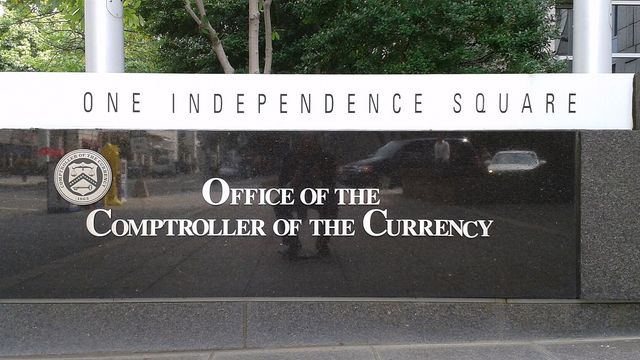
13 of the OCC's 21 New Trust Banks Are Crypto Firms — ICBA Just Sued and Rain Filed for One Too
Rain filed for a New York national trust bank on Oct 5, three days after ICBA sued to void the OCC charter rule behind 13 of the 21 crypto-heavy approvals.

Thailand Opens the SET to Bitcoin and Ether ETFs on October 16 — and 20% of Its Population Already Holds Crypto
Thailand's SEC finalized rules for Bitcoin and Ether ETFs listed on the SET from Oct. 16: 80% single-asset exposure, no margin loans, SEC-regulated custody.

Starknet Ran 99% in a Week to a 10-Month High — the $0.0836 Retrace Decides $0.1313 or $0.0701
Starknet ran 99% in a week to its highest print since December — and 127 million STRK unlock on October 15. The $0.0836 retrace decides $0.1313 or $0.0701.